

Hey there! As a diesel water pump supplier, I know how crucial it is to test the performance of these pumps. Whether you're using them for farming, industrial applications, or other tasks, a well - performing diesel water pump can save you a lot of time and money. In this blog, I'll share some practical ways to test the performance of a diesel water pump.
1. Pre - test Checks
Before you start testing the pump, there are a few things you need to do. First, check the physical condition of the pump. Look for any signs of damage, like cracks in the casing, loose bolts, or worn - out parts. A damaged pump won't perform well, and it might even break down during the test.
Next, make sure the diesel engine is in good shape. Check the oil level, fuel level, and coolant level. A low oil level can cause engine damage, while insufficient fuel or coolant can lead to overheating and poor performance. Also, inspect the air filter. A dirty air filter restricts air flow to the engine, which can reduce its power.
2. Flow Rate Testing
One of the most important performance indicators of a diesel water pump is its flow rate. The flow rate tells you how much water the pump can move in a given time. To test the flow rate, you'll need a measuring container and a stopwatch.
First, set up the pump and make sure it's properly connected to the water source. Start the pump and let it run for a few minutes to reach a stable operating condition. Then, place the measuring container under the pump's outlet. Start the stopwatch as soon as water starts flowing into the container. After a certain period, say 60 seconds, stop the stopwatch and measure the volume of water in the container.
To calculate the flow rate, divide the volume of water (in liters or gallons) by the time (in seconds) and then multiply by 60 to get the flow rate per minute. For example, if you collect 100 liters of water in 60 seconds, the flow rate is 100 liters per minute.
If the measured flow rate is significantly lower than the pump's rated flow rate, there might be a problem. It could be due to a clogged impeller, a worn - out pump seal, or an issue with the engine's power output.
3. Head Pressure Testing
Another key performance parameter is the head pressure. Head pressure refers to the height to which the pump can lift water. To test the head pressure, you'll need a pressure gauge.
Connect the pressure gauge to the pump's outlet. Start the pump and let it run until it reaches a stable operating condition. Read the pressure on the gauge. The head pressure can be calculated from the pressure reading using the formula: Head (in meters) = Pressure (in kPa) / (Density of water x Gravity). The density of water is approximately 1000 kg/m³, and the acceleration due to gravity is 9.81 m/s².
If the measured head pressure is lower than the rated head pressure, it could indicate problems such as a damaged impeller, a leak in the pump system, or insufficient engine power.
4. Efficiency Testing
Efficiency is a measure of how well the pump converts the input power (from the diesel engine) into useful work (pumping water). To test the efficiency, you need to measure the input power and the output power.
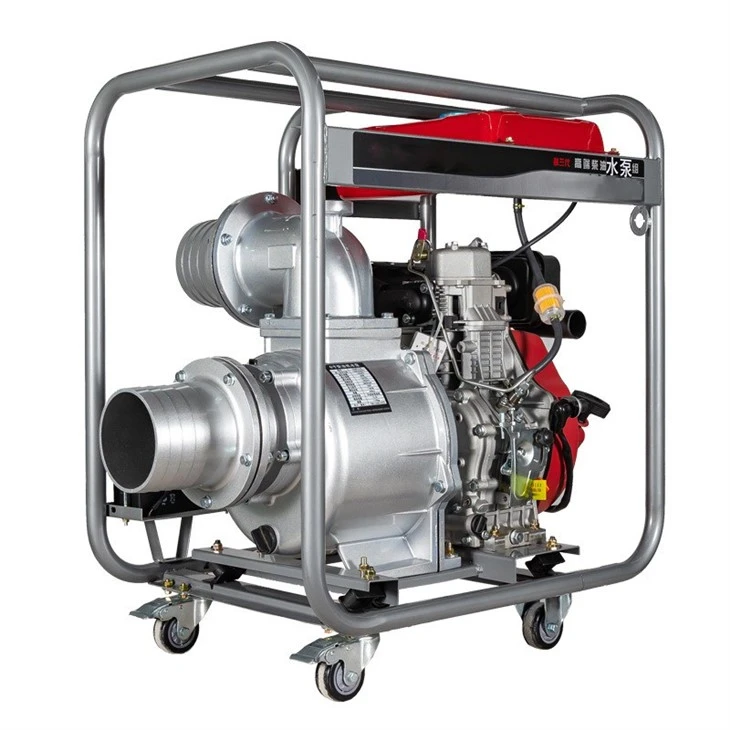

The input power can be estimated by measuring the fuel consumption of the diesel engine. You can use a fuel flow meter to measure the amount of fuel consumed by the engine over a certain period. The output power can be calculated from the flow rate and head pressure using the formula: Output Power (in watts) = Flow Rate (in m³/s) x Density of water x Gravity x Head (in meters).
The efficiency of the pump is then calculated as: Efficiency = (Output Power / Input Power) x 100%. A low efficiency might mean that the pump is not operating optimally, and it could be due to factors like mechanical losses, hydraulic losses, or engine inefficiencies.
5. Noise and Vibration Testing
Excessive noise and vibration can be signs of problems in a diesel water pump. To test for noise, you can use a sound level meter. Place the sound level meter at a fixed distance from the pump (usually 1 meter) and measure the noise level while the pump is running. Compare the measured noise level with the pump's specifications.
For vibration testing, you can use a vibration meter. Attach the vibration meter to the pump's casing and measure the vibration amplitude and frequency. High vibration levels can be caused by unbalanced rotating parts, misaligned components, or loose mounting.
6. Durability Testing
Durability is also an important aspect of a diesel water pump's performance. To test the durability, you can run the pump continuously for an extended period, say 24 hours or more. During this time, monitor the pump's performance parameters, such as flow rate, head pressure, and temperature.
Check for any signs of wear and tear, like leakage, overheating, or unusual noises. A pump that can maintain its performance over a long - term operation is considered to be durable.
Our Product Recommendations
We offer a range of high - quality diesel water pumps. For example, the Light Weight Large Flow Portable Diesel Operated Irrigation Water Pump for Farming is perfect for small - to - medium - sized farms. It's lightweight and easy to move around, and it has a large flow rate, which means it can irrigate a large area quickly.
If you're looking for an air - cooled diesel engine - driven pump for agriculture, our Agriculture Air Cooled Diesel Engine Driven Irrigation Water Pump is a great choice. The air - cooled engine makes it suitable for areas with limited water supply for cooling.
For irrigation transfer tasks, our Diesel Powered Driven Irrigation Transfer Pump is designed to provide reliable and efficient water transfer.
Conclusion
Testing the performance of a diesel water pump is essential to ensure its proper operation and longevity. By following the steps outlined in this blog, you can accurately assess the pump's flow rate, head pressure, efficiency, noise, vibration, and durability.
If you're in the market for a diesel water pump or need more information about pump testing, feel free to reach out. We're here to help you find the right pump for your needs and ensure it performs at its best.
References
- "Pump Handbook" by Igor J. Karassik et al.
- "Diesel Engine Theory and Operation" by Richard H. Mathias.